Bees settle on properties that offer both an accessible cavity and conditions that make scouting worthwhile. You will learn how to inspect and close likely entry points, reduce avoidable attractants, recognise a passing swarm, and choose a safe response before a colony establishes comb.
Key takeaways
- Seal dry cavities only after confirming no bees are inside.
- Inspect roof edges, vents, sheds and wall gaps for sheltered nesting sites.
- Do not treat a swarm as an established honeycomb nest.
- Use relocation for accessible colonies and professional removal for hazardous sites.
Close the cavities bees use before they find them
Bees establish colonies when a small entrance leads to a dry, protected cavity. Fix those access points before scout bees find them, but confirm that no bees are inside first; sealing an active entrance can trap the colony and drive bees into rooms or ceiling spaces.
| Property defect | Repair to make | What goes wrong if ignored |
|---|---|---|
| Wall cracks, masonry gaps and loose flashing | Seal cracks with durable exterior sealant or mortar | Bees reach wall voids that are difficult to open safely |
| Gaps around pipes, cables and meter boxes | Fit tight collars and close the surrounding joint | Narrow service openings become sheltered entrances |
| Missing or lifted roof tiles and eaves gaps | Cover roof openings with properly fitted materials | A roof cavity stays dark, dry and protected from weather |
| Open chimney tops and uncapped flues | Install a suitable chimney cap without blocking ventilation | Bees can enter a tall, undisturbed void |
| Open ventilation grilles | Screen vents with fine metal mesh while preserving airflow | Large openings admit bees and other insects |
| Damaged soffits repair | Replace broken soffit sections and secure loose edges | Bees gain access above ceilings and behind fascia boards |
Inspect shutter boxes, balcony ceilings, loft hatches, sheds and hollow posts for gaps wider than a few millimetres. Do not rely on expanding foam alone: weather, chewing and movement can reopen weak repairs.
Never close a hole that has repeated bee traffic, buzzing behind it, wax, honey or visible comb. Arrange assessment first, then remove the colony and repair the cavity so residual comb and odour do not attract another swarm.
Inspect every sheltered space and remove avoidable attractants
Walk the entire boundary with a property inspection checklist, looking for places that offer darkness, shelter and a protected cavity rather than trying to remove every flowering plant. Pay special attention after storms, roof repairs and renovations, when new gaps can expose attractive nesting spaces.
- Check tree hollows, roof eaves, loose roof tiles, chimneys, damaged soffits and cracks around masonry.
- Inspect balconies and lofts, shutter boxes, meter boxes, sheds and unused containers.
- Look behind vents and chimney caps, and around pipe, cable and other service penetrations.
- Check for dripping taps, leaking pipes, blocked drains, standing water, fallen fruit and refuse bins with uncovered lids.
- Remove sweet drink residue, food scraps and spilled syrup from outdoor tables, bins and pet-feeding areas.
| Condition | Why scouting bees may investigate | Practical response |
|---|---|---|
| Sheltered cavity | A dry wall void, loft or tree hollow can protect a future colony from weather and disturbance | Arrange repair or screening without blocking required ventilation |
| Sweet food or refuse | Sugar residue and exposed waste provide an easy food source | Clean spills and keep bins, drinks and food covered |
| Accessible water | Leaks, trays and puddles provide drinking water, especially during hot weather | Repair leaks and empty or manage containers regularly |
| Flowering plants | Flowers supply forage but do not usually explain a colony inside a building | Keep healthy plants; focus prevention on nearby cavities |
If bees repeatedly enter one opening, do not seal it while they are active. Trapping a colony inside can drive bees indoors and leave comb and honey behind.
Identify a swarm before treating it as a nest
An exposed cluster hanging from a branch, railing, signboard or building edge is usually a temporary swarm, not an established colony. Thousands of honey bees may gather there for a few hours or several days while scout bees search for a cavity.
Do not spray the cluster; keep people away and contact a beekeeper for relocation.
An established colony shows repeated bee traffic into one opening, such as a roof gap, wall crack, chimney or utility box. Look for bees disappearing into the same point throughout the day, then listen for a steady buzz.
If the cavity is opened safely, wax comb, brood and stored honey confirm occupation; killing visible adults alone leaves material that attracts another swarm, ants or wasps.
Use this field check before choosing any treatment:
- Watch the flight path from a safe distance. A cluster with no fixed entrance suggests a swarm; bees repeatedly entering a hole suggest a colony.
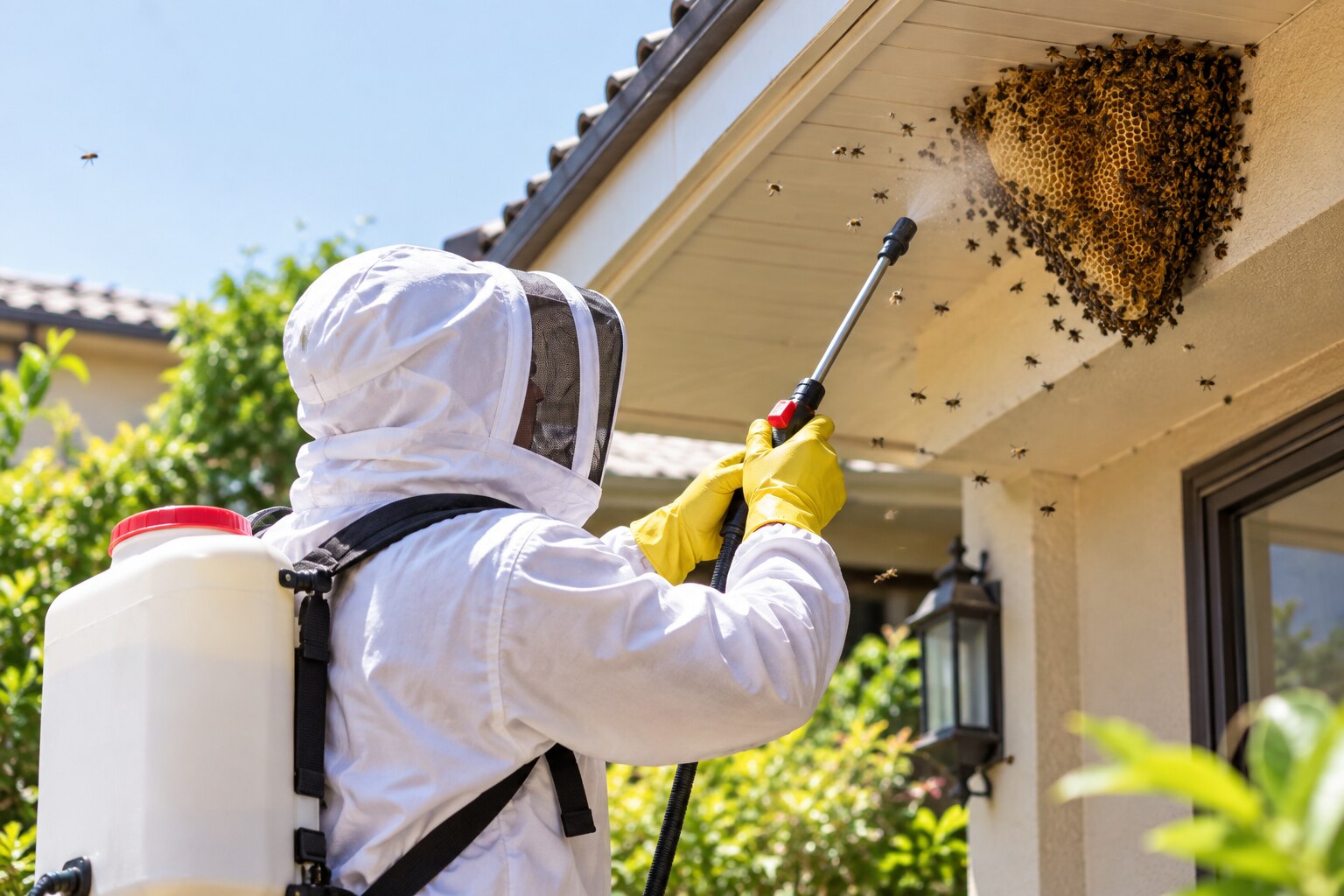
- Look at the nest material without disturbing it. Honey bees build exposed, orderly wax comb; wasps and hornets build papery nests, often enclosed or hanging beneath an overhang.
- Check the insects’ shape. Honey bees have bulky, hairy bodies, while wasps and hornets look smoother, narrower-waisted and more sharply marked.
Treat a large cluster, an entrance-adjacent colony or activity near a school, hospital, food business or busy walkway as a professional-call situation. Disturbance can trigger defensive behaviour and multiple stings.
Choose relocation or removal based on location and risk
Call a beekeeper before using chemicals when you find a live swarm or an accessible honey-bee colony. Relocation protects the colony when the site can be isolated safely; removal needs a qualified removal professional when bees occupy a wall and electrical area, roof, sign, or another enclosed structure.
| Option | Call this professional | When it applies |
|---|---|---|
| Beekeeper relocation | A beekeeper who collects live colonies | Exposed swarm or accessible nest away from immediate danger |
| Arborist support | An arborist working with a beekeeper | Comb is inside a tree hollow, high branch, or damaged trunk |
| Removal and repair | A qualified removal professional, building contractor, or pest-control professional | Bees occupy a wall, roof, sign, utility void, or electrical area |
Ask who will open the structure, recover or remove the queen, comb, brood and honey, and repair the entry point. A beekeeper may save the colony but cannot remove inaccessible material or restore damaged masonry, soffits, wiring covers, or roofing.
Before work begins, confirm these points:
- The entrance and nearby people can be isolated during removal.
- No one will seal the opening while bees remain inside.
- The method excludes fire, boiling water, petrol, kerosene, aerosol insecticide and improvised smoke.
- The plan includes removing residual wax, honey and contaminated material, then cleaning and sealing the cavity.
- The contractor will identify who handles electrical isolation before opening an electrical area.
In Thane, Doctors Pest Control Service 9820089331 can help assess whether a bee problem needs treatment, cavity access, or post-removal sealing rather than a quick surface spray. Expect a professional to recommend chemical control only when safe live relocation is not practical.
Related product
HONEY BEE PEST CONTROL Honey Bees generally do not harm or pose any threat to humans. Honeybees produce honey from pollen and nectar of the plants they pollinate. View product → |
Seal, clean and monitor the site after the bees are gone
Remove the comb, stored honey and brood from the cavity; killing or relocating adult bees alone leaves the strongest attractants behind. Residual wax and honey can feed ants and wasps, while the remaining colony odour can draw robbing bees or a replacement swarm.
Use this follow-up sequence:
- Open the cavity where necessary and remove comb, brood, honey-soaked material and contaminated insulation.
- Clean residual honey and wax from reachable timber, masonry and other surfaces with warm water and detergent, then dry the area completely.
- Seal the cavity with durable materials suited to the defect, such as mortar for masonry gaps, metal mesh for vents or sheet metal for larger openings. Do not close an entrance while bees remain inside.
- Cover refuse, sugary spills and fallen fruit, and repair nearby dripping taps or leaking pipes so the cleaned site has fewer competing attractants.
Watch for renewed bee traffic after the work. Bees repeatedly entering one crack, vent or roof edge indicate that an opening was missed or that part of the colony remains; keep people away and arrange another inspection rather than spraying the flight line.
Schedule a seasonal inspection in warm weather, especially after nearby swarming activity. Check sealed cavities, roof edges and previously occupied walls for fresh bees, wax flakes or a sweet smell, because a small defect can restart the problem before a new comb becomes visible.
Frequently asked questions
Should you seal a cavity where bees are entering?
Yes, but first confirm that no bees are inside. Sealing an active entrance can trap the colony and push bees into rooms or ceiling spaces.
How can you tell a swarm from an established nest?
A swarm is a temporary cluster of bees gathered around a queen, while an established nest uses a protected cavity and includes regular bee traffic through an entrance.
When should bees be relocated instead of removed?
Choose relocation when the colony is accessible and can be moved safely. Use professional removal when bees are inside walls, roofs, ceilings or other hazardous spaces.
What should you do after bees are gone?
Seal the entry point, remove remaining comb and residue, clean attractants, and monitor the area for renewed bee activity.