Fresh droppings, greasy marks along a wall, scratching after dark, or a new urine odour can reveal a rat problem before you see an animal. You will learn how to identify the evidence, take safe first steps, close entry routes, understand trap limitations, and judge whether the infestation has actually ended.
Key takeaways
- Fresh, glossy droppings indicate recent rat activity.
- Seal gaps around pipes, doors, drains, and utility lines.
- Use traps carefully; bait alone rarely fixes the entry route.
- Wear gloves and disinfect droppings before removing them.
How to recognise a rat infestation before it grows
Fresh rat droppings are one of the clearest signs of an early rat infestation. Rat droppings are usually larger than mouse droppings, dark, blunt-ended, and found along walls, under sinks, behind appliances, or near food. New droppings look moist or glossy; old ones become dry and dull.
A single day without droppings does not prove the activity has stopped.
Check for gnaw marks on food packaging, wood, plastic and electrical cables. Greasy rub marks along skirting boards, scratching in walls or false ceilings, urine odour, shredded nesting material, tracks in dusty areas, burrows and disturbed bait all support an active infestation.
- Photograph each sign and record its location.
- Inspect behind appliances, inside cupboards, under sinks and around drains.
- Isolate food, remove pet food overnight, and secure rubbish in closed containers.
- Recheck the same locations for fresh rat droppings, new damage or movement.
Rat evidence differs from mouse evidence in several useful ways:
| Sign | Rat | Mouse |
|---|---|---|
| Droppings | About 12–20 mm, thicker and blunt-ended | About 3–6 mm, narrow and pointed |
| Entry gap | Can squeeze through about 12 mm | Can use gaps around 6 mm |
| Noise | Heavier scratching, movement or gnawing | Lighter, quicker sounds |
| Harbourage | Drains, wall voids, roof spaces and outdoor burrows | Cupboards, appliance voids and small concealed spaces |
Why a small rat problem deserves action now
A rat sighting is not reliable evidence of one stray animal. Norway rats have a gestation period of 21–23 days, and females produce litters of several young. Waiting for more droppings or daytime sightings gives an unseen population time to expand.
That is why early action matters: delay permits repeated contamination, gnawing damage to wiring and concealed nesting in wall voids or storage spaces.
Removing food alone rarely ends the problem. Rats also need water and shelter; a leaking pipe or accessible refuse area can sustain them. In a kitchen or food store, exposed bait is an unacceptable fix because rodents may carry it into food areas and poisoned rats may die inside walls.
Use secured, tamper-resistant bait stations only as the product label directs, and retain inspection and corrective-action records.
Use this practical first-response checklist today:
- Isolate food in sealed, wipeable containers.
- Remove pet food and water overnight.
- Secure rubbish and clean spills without scattering contaminated material.
- Inspect under sinks and behind appliances for moisture, gaps and fresh activity.
- Record where signs appear, including the date and room.
- Escalate heavy contamination or activity inside a wall, ceiling or shaft for professional assessment.
Where rats enter and how to block the route
Treat any gap approaching a 12 mm rat opening as a possible route, even if it looks too small for a large rat. Rats compress their bodies, and sealing only obvious holes leaves the building connected to drains, voids and outdoor harbourage.
Inspect these rat entry points closely:
- Utility pipe gaps around water, gas, air-conditioning and electrical lines, especially where pipes pass through walls, floors or ceilings.
- Drain outlets, broken drain covers and gaps around floor drains.
- Door gaps beneath external, basement and garage doors; a door sweep closes the lower edge.
- Ventilation openings, service ducts, lift shafts and electrical shafts.
- Roof edges, wall cracks, false ceilings and damaged cladding.
- Basement corners, construction debris and vegetation touching exterior walls.
Use a repair that resists gnawing and remains fixed when the wall moves slightly. The best material depends on the opening:
| Opening or defect | Durable repair | Why it works |
|---|---|---|
| Utility pipe gaps | Mortar or cement packed around metal mesh | Closes the void around irregular pipes |
| Vent or duct opening | Galvanised hardware cloth, firmly screwed in place | Blocks rats while allowing airflow |
| Drain outlet | A tight-fitting metal grate or repaired drain cover | Prevents access through the drainage line |
| Door gap | Metal-backed door sweep with side seals | Closes the moving edge without blocking the door |
| Wall or roof crack | Cement mortar, with metal mesh behind larger voids | Provides a hard surface rats cannot easily gnaw |
Do not rely on expanding foam alone: rats can chew through it. Remove stored materials that form concealed runways, or repeated baiting and trapping will not solve an open route.
What traps and bait can—and cannot—do
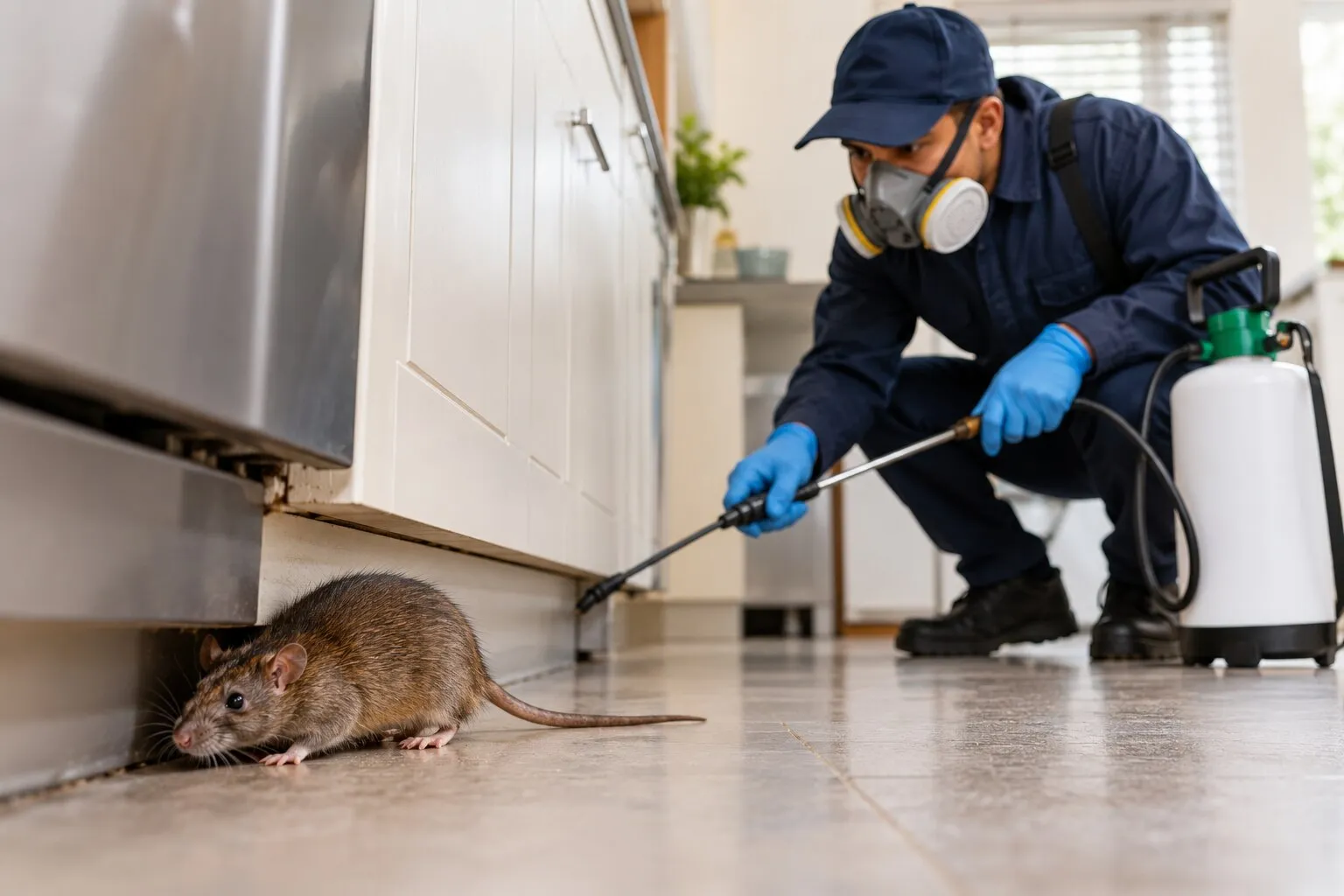
Use snap traps on active routes, not in the middle of a room. Rats follow edges, so rat trap placement works best with snap traps against walls and the baited or trigger end facing the wall.
For safer use:
- Keep traps and bait away from children, pets, food, utensils and food-contact surfaces.
- Use a small amount of bait that will not fall away, and check traps regularly according to the manufacturer’s instructions.
- Treat bait selection as a safety decision: never scatter loose rodenticide. If bait is necessary, put it inside a tamper-resistant station and follow the product label.
- Record each trap or station location, especially in a kitchen, shop or food-storage area.
Traps can remove rats already inside, but they cannot seal a gap or stop a new animal from entering. Bait can also leave a poisoned rat dead inside a wall or ceiling, causing a persistent odour. Sanitation removes accessible food, water and shelter; exclusion closes entry points. You need both.
That combination is integrated pest management: inspect, remove attractants, trap or use secured bait, repair openings, and monitor for fresh droppings or gnawing. Disinfectant spraying, fogging and deodorising only address contamination or smell; they do not control the infestation.
If signs continue after trapping, search again for hidden food, water, harbourage and entry routes instead of adding more bait.
How to clean safely and confirm the problem is over
Dry sweeping or vacuuming can put contaminated dust into the air. For safe rat droppings cleanup, ventilate the area, keep people and pets out, and wear disposable gloves and waterproof footwear. The footwear matters during leptospirosis exposure risk after flooding, leaks, or contact with wet soil, drains, or urine.
Do not disturb nests until they are thoroughly wet.
- Spray droppings, nesting material, and nearby surfaces with a disinfectant suitable for the material. Keep them visibly wet for the contact time printed on the label.
- Pick up the softened waste with paper towels, wipe the area again, and place everything in a bag.
- Seal that bag inside a second bag before disposal. Wash gloved hands before removing the gloves, then wash your hands.
- Stop and arrange professional assessment for heavy accumulation, a confined space, strong urine odour, or contamination inside ventilation or wall voids.
Disinfectant, fogging, and deodoriser reduce surface contamination or smell; they do not prove that rats are gone. Follow-up monitoring should show no new droppings, tracks, gnawing, urine odour, or trap activity across several consecutive inspections, while sealed entry points remain intact.
Ask Doctors Pest Control Service 9820089331 to document inspection points and corrective work if the signs continue.
At a food premises, inspect bait stations and storage areas so no bait touches food, utensils, or food-contact surfaces. Retain food premises pest-control records showing dates, findings, products used, station checks, and corrective action. Loose bait left in a kitchen is evidence of poor control, not successful treatment.
Related products
RODENT PEST CONTROL Rodents are mammals of the order Rodentia, from the Latin rodere “to gnaw”. View product → |
 | Rodent Control Service Protect your home and workplace from rats and mice with our reliable Rodent Control Service in Thane. View product → |
Frequently asked questions
How can you tell whether rat droppings are fresh?
Fresh rat droppings look moist or glossy, while older droppings become dry and dull. They are usually dark, blunt-ended, and larger than mouse droppings.
Why should you act when you find only a few droppings?
A small number of droppings can indicate an active rat using your home for food or shelter. Early action gives you a better chance to remove the rat and seal its entry route before damage and contamination spread.
Where should you look for rat entry points?
Inspect gaps around pipes, drains, doors, windows, wall joints, utility lines, and damaged vents. Check routes leading from kitchens, storerooms, garages, and rubbish areas.
Do traps and bait solve a rat infestation on their own?
Traps can remove individual rats, but they do not close entry points or remove food sources. Bait also creates risks for children, pets, and wildlife, so use it only according to the product label or with professional guidance.
How should you clean rat droppings safely?
Ventilate the area, wear disposable gloves, soak droppings with disinfectant, and wipe them up. Do not sweep or vacuum dry droppings because that can put contaminated dust into the air.