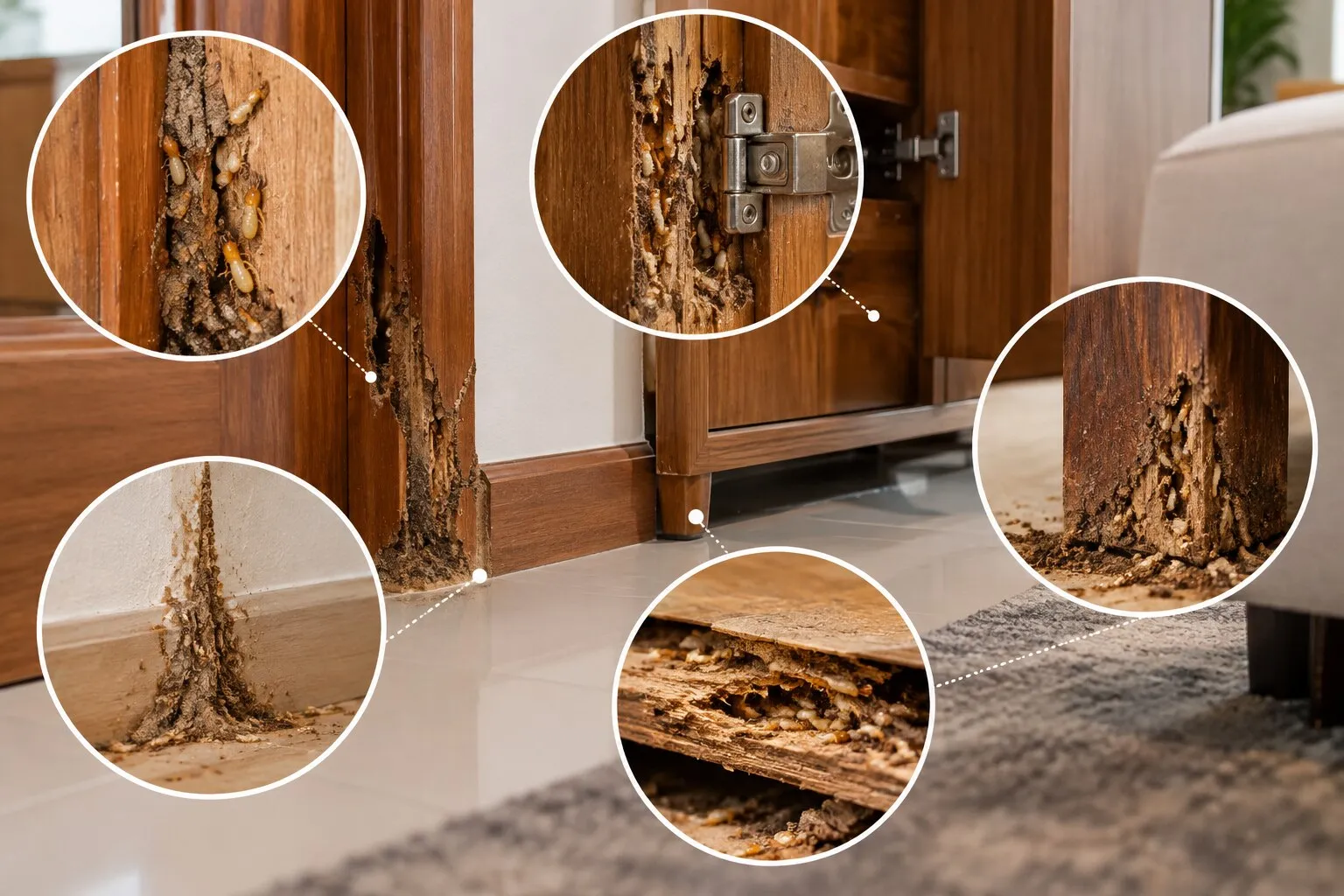
Termites can remain behind paint, plaster, tiles, skirting, laminate and built-in furniture while the visible room appears intact. By checking entry routes, moisture points, room-specific hiding places and physical evidence in the right order, you can identify where to investigate before disturbing the property or treating only the first sign you find.
Key takeaways
- Check cracks, joints, service gaps, and wall-floor junctions first.
- Inspect damp areas beneath sinks, bathrooms, balconies, and leaking pipes.
- Look for mud tubes before removing plaster or opening walls.
- Match mud tubes to subterranean termites and drywood pellets to drywood termites.
How Termites Get From Outside Into Concealed Building Spaces
Subterranean termites reach concealed building spaces through the smallest continuous gap between soil and structure. They do not eat concrete or electrical insulation; they travel through cracks, joints, voids and adjacent timber, then build mud tubes behind finishes or inside cavities.
| Route | Concealed destination | What to check |
|---|---|---|
| Foundation cracks | Wall cavities, floors and skirting | Earthen tubes, damp staining or fine gaps at the slab edge |
| Expansion joints | Wall bases, service zones and false floors | Mud lines crossing the joint or disappearing beneath finishes |
| Plumbing penetrations | Bathroom walls, kitchen cabinets and door frames | Gaps around pipes, damaged sealant and moisture-softened wood |
| Cable conduits | Electrical chases, switch areas and service ducts | Soil-like deposits beside the conduit, not chewed insulation |
| Soil touching walls | Skirting, lower plaster and structural timber | Continuous mud shelter from ground level upward |
| Damp masonry | Frames, flooring and concealed wood | Blistered paint, peeling plaster or a hollow sound |
A pipe or conduit alone does not attract termites; persistent moisture makes the route usable. Leaking drains, air-conditioner lines, gutters and failed waterproofing can keep masonry wet while termites move toward untreated structural wood. They may then spread into wall voids, beneath wooden flooring, inside staircases or above a false ceiling.
Trace any tube back toward the nearest soil contact, crack or joint instead of assuming the visible damage marks the entry point.
Room-by-Room Places to Check First
Start with fixed timber, wall edges and damp service points rather than open floor space. Check each area for mud tubes, blistered paint, pinholes, hollow-sounding wood, frass, discarded wings or sagging timber.
- Living rooms: Inspect skirting boards, wall panelling, wooden flooring, door and window frames, architraves and concealed wall voids. Tap suspicious trim lightly; a hollow sound deserves closer examination.
- Bedrooms: Examine bed platforms, wardrobes, built-in cupboards, loft access panels and the lower ends of door frames. Check electrical conduits behind fixed panels if paint blisters or pinholes appear nearby.
- Kitchens: Look inside sink cabinets, behind kitchen cabinetry and at floor-wall junctions. Inspect plumbing chases and pipe penetrations where leaks, damp plaster or damaged waterproofing could keep timber wet.
- Bathrooms and utility areas: Check bathroom door frames, tiled floor-wall junctions, drain and pipe penetrations, and nearby skirting. Plumbing alone is not the warning sign; persistent moisture is.
- Storage areas: Move cardboard cartons, wooden boxes and stored furniture before inspecting the wall behind them. Include lofts, staircases, wooden racks and any timber touching damp masonry.
- Commercial premises: Inspect pallet stacks, incoming wooden pallets, packaging, archive rooms, false floors, kitchen cabinetry, false ceilings and expansion or service zones that routine cleaning rarely reaches. Look behind racks and below raised flooring, not only in customer-facing rooms.
A ceiling stain does not prove termite activity, but inspect the false ceiling, service ducts and nearby timber while investigating the leak. If a fixed finish blocks access, photograph the evidence first and remove only a small section of trim when necessary.
Moisture Points That Make Concealed Hiding Places More Likely
A leak does more than stain a surface: it creates the damp, protected conditions termites favour behind finishes. Check the area around a dripping pipe, failed bathroom waterproofing, seepage through masonry, or condensation caused by poor ventilation. Persistent moisture matters; plumbing alone does not attract termites.
- Inspect wall voids near damp patches, peeling paint, bubbling plaster, or a skirting board that has swollen away from the wall. A concealed mud tube may appear only as a narrow repaired-looking strip at a crack.
- Check floor-wall junctions around bathrooms, kitchens and utility areas. Damaged waterproofing can let moisture reach the joint, while termites use cracks, construction joints and adjacent timber to remain hidden.
- Follow plumbing chases and electrical conduits through wet rooms and service areas. Termites do not eat concrete, cable insulation or conduit, but these routes can connect soil, cracks and concealed wood.
- Look above stained false ceilings and inside poorly ventilated service ducts. A ceiling stain proves a leak, not termites, but damp timber or a concealed tube makes the area worth inspecting.
Do not treat every damp mark as termite evidence. Repair the leak, improve airflow and check nearby wood for hollow sounds, pinholes, blistering or frass; workers can remain inside the wall or floor after the visible moisture dries.
Examine windows, lights and drains for discarded wings, which point to a swarm event rather than the colony’s exact location.
How to Inspect Without Immediately Opening Walls
Start with the least destructive checks, then open only a location that shows several matching clues. A hollow-sounding wood panel or blistered paint alone can result from moisture, beetles, carpenter ants or poor workmanship.
1. Photograph each room from the doorway, then inspect skirting boards, floor-wall junctions, door and window frames, cupboards, staircases and wooden flooring. Look for repaired-looking strips, pinholes, mud tubes, sagging laminate and discarded wings.
2. Follow suspicious lines upward and sideways to plumbing chases, electrical conduits, service ducts, false ceilings and wall cracks. Photograph ceiling stains and damp patches too; they identify areas for leak investigation, not proof of termites.
3. Use a torch and a thin probe on accessible, unfinished timber. Test skirting ends, frame joints and exposed floor edges for softness, galleries or a thin concealed tube. Stop if probing could contact wiring or plumbing.
4. In lofts, roof spaces and storage areas, inspect timber joints, cardboard stacks and kick-out holes. Photograph loose frass beneath holes, blistered veneer, live insects and shed wings. Drywood termites can leave hard pellets without a visible soil route.
5. Mark every photograph with the room, wall or beam location, date and a size reference such as a ruler. Take one close image and one wider image showing its position.
Old mud tubes, dead insects and previous repairs show history, not active infestation; confirm activity by finding live termites, fresh material, monitoring or carefully opening the suspect spot.
Subterranean or Drywood? Match the Evidence to the Hiding Site
Soil-connected activity leaves a route as well as damage. Look for mud tubes inside wall cavities, behind skirting, at floor-wall junctions, or beneath wooden flooring; these may rise from foundation cracks, plumbing penetrations, or damp masonry.
Old tubes prove only that termites used the path before, so confirm activity with live insects, fresh repairs, or monitoring.
| Evidence | More consistent with subterranean termites | More consistent with drywood termites |
|---|---|---|
| Route | Mud tubes linking soil, walls, service ducts, or plumbing chases | No visible soil route |
| Material | Damp structural wood, skirting, wall panels, and floor edges | Relatively dry timber in lofts, roof spaces, staircases, or partitions |
| Waste | Mud and softened wood | Small, hard faecal pellets falling from pin-sized kick-out holes |
Drywood activity can remain isolated inside a frame, staircase, loft beam, or wooden flooring. Check beneath laminate edges, inside stored cardboard, and around false ceilings, but do not treat discarded wings near a window or light as the source; a swarm only shows that mature termites emerged nearby.
Professional inspection earns its cost when pellets recur, wood sounds hollow, finishes hide the suspected area, or damage appears in several rooms. A trained inspector can probe timber, use targeted monitoring, and lift a small trim section instead of opening a wall blindly.
Doctors Pest Control Service 9820089331 can help decide whether the evidence warrants local treatment or a wider search.
Related products
TERMITE CONTROL TREATMENT ₹10000 White ants or termites are one of the most dangerous wood destroying organisms. Termites are social insects. View product → |
 | Termite Control Service Protect your assets from expensive damage by termites with our professional Termite Control Service in Thane. View product → |
Frequently asked questions
How do termites get from outside into concealed building spaces?
Subterranean termites follow continuous routes from soil into cracks, joints, service gaps, wall voids, and adjacent timber. They can build mud tubes behind finishes or inside cavities.
Where should you check for termites room by room?
Start at skirting boards, door and window frames, built-in cabinets, plumbing penetrations, bathroom edges, kitchen units, and timber that touches damp masonry or floors.
Which moisture points make concealed termite hiding places more likely?
Check leaking pipes, sink cabinets, bathrooms, roof or balcony leaks, blocked drains, damp plaster, and areas with poor ventilation. Moisture supports concealed termite routes and damages timber.
How can you inspect for termites without opening walls?
Use a flashlight to examine joints and finishes, tap timber for hollow sounds, check for mud tubes or frass, inspect moisture points, and record fresh damage before cutting into a wall.
How can you distinguish subterranean termites from drywood termites?
Mud tubes connecting soil or masonry to timber indicate subterranean termite activity. Small piles of pellet-like frass beneath timber and no soil connection point toward drywood termites.